tl;dr
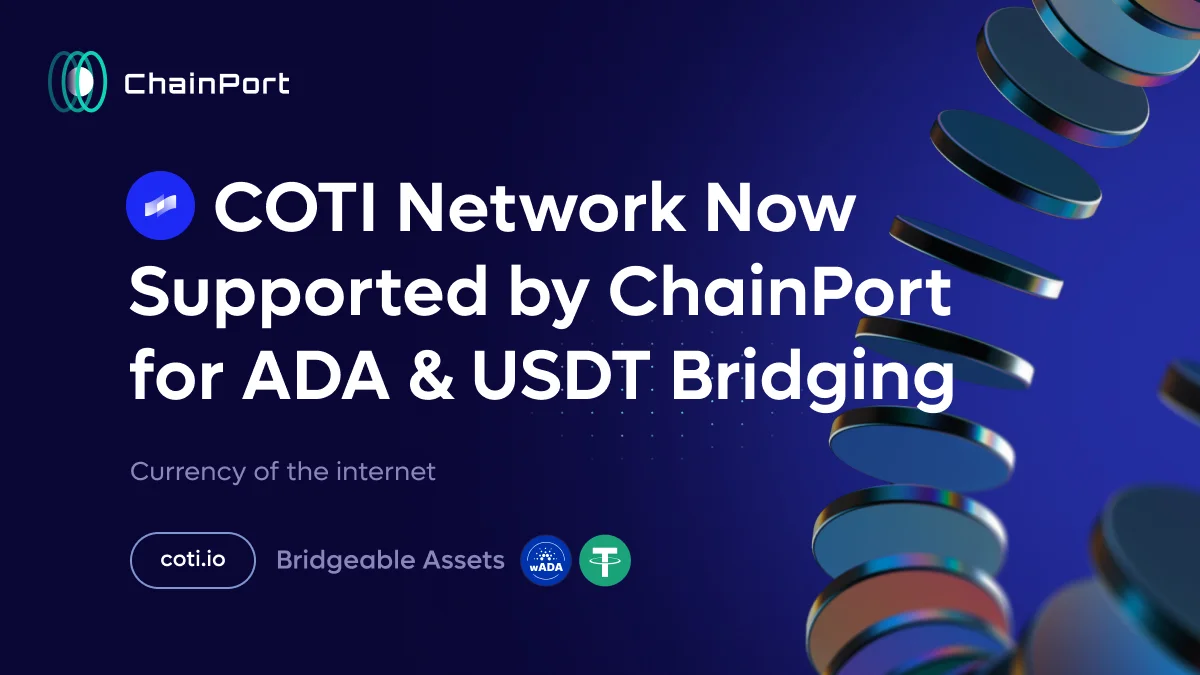
- ChainPort has integrated COTI, becoming the 28th supported blockchain on the bridge.
- COTI is the programmable privacy layer for Web3, delivering fast, low-cost, and flexible confidentiality across any blockchain.
- COTI uses Garbled Circuits (GC), a high-performance privacy layer for maximum scalability and efficiency.
- Users can now bridge USDT across multiple chains to COTI, as well as ADA from Cardano to COTI
COTI Integration Marks New Milestone for ChainPort
ChainPort has officially integrated COTI, marking it as the 28th blockchain supported on the bridge. This integration strengthens ChainPort’s mission to connect innovative blockchain ecosystems and expand cross-chain interoperability.
With this integration, users can now bridge ADA to wADA (wrapped ADA) for transfers from Cardano to COTI, as well as bridge USDT from multiple major networks directly to COTI.
Supported networks for USDT bridging to COTI include: Chillz, Ethereum, BNB Chain, Polygon, Arbitrum, Avalanche, Optimism, Base, and Stratis. This significantly enhances liquidity and usability within the COTI ecosystem.
wADA on COTI Contract Address: 0xe757Ca19d2c237AA52eBb1d2E8E4368eeA3eb331
USDT on COTI Contract Address: 0xfA6f73446b17A97a56e464256DA54AD43c2Cbc3E
COTI is the programmable privacy layer for Web3. Powered by high-performance Garbled Circuits, COTI delivers industry-leading fast, low-cost, flexible, and compliant privacy to any blockchain. Its EVM mainnet launched in March 2025, enabling confidential smart contracts, end-to-end encryption, selective disclosure, and multichain composability.
Garbled Circuits outperform other privacy protocols in speed (up to 3,000x faster), efficiency (250x lighter), and cost, making COTI the most scalable confidentiality layer in Web3. Its full-stack privacy supports next-generation use cases across DeFi, payments, identity, governance, AI, and private RWAs, while inheriting full Ethereum security and EVM compatibility. This integration with ChainPort enables secure bridging, greater interoperability, and enhanced liquidity for developers and enterprises building privacy-preserving financial applications across multiple chains
How to Bridge ADA from Cardano to wADA on COTI in 3 Steps
Below is a step-by-step guide on how to bridge ADA tokens from Cardano to COTI. By changing the source and target chains, token holders can also bridge ADA in the opposite direction, from COTI to Cardano.
In addition to ADA, USDT bridging to COTI is also supported via ChainPort. Users can bridge USDT from multiple major networks into the COTI ecosystem, including Chillz, Ethereum, BNB Chain, Polygon, Arbitrum, Avalanche, Optimism, Base, and Stratis. All major EVM wallets are supported for USDT bridging.
Step 1 - Connect Your Wallet
Go to ChainPort's bridge (https://app.chainport.io/) and connect your wallet. ChainPort supports Nami, Eternal, and Yoroi wallets on Cardano. Select the wallet with the Cardano-based ADA tokens you wish to bridge to COTI.
%20(1).webp)
Step 2 - Select the Chains & Token
In the drop-down menu, select the source blockchain and the target blockchain. In our case, the source chain is Cardano, and select ADA as the token you wish to bridge from the dropdown menu. Then, choose COTI as the destination chain.
.webp)
Step 3 - Confirm Tx & Get Tokens
Review all related information, including gas fees and the token, before confirming the transaction. Once you have confirmed all details, approve the transaction and wait a few minutes for it to be processed. Afterward, your ADA tokens have been successfully bridged from Cardano to COTI as wADA.
%20(1).webp)
ChainPort | Twitter | Telegram | ChainPort News | Documentation | Medium | Reddit